A predictable structure they can trust.
- Clear, consistent expectations across every classroom and setting.
- Real-time support that meets them where they are.
- Functional skills that transfer beyond your room.
Built by special education teachers, for the students they serve. The whole student support suite, in one place.
For teachers, S4S is a tracking tool that gives time back — log tasks, behavior, and supports in seconds during class, and the reports and family updates build themselves from what you’ve already recorded. Less evening paperwork. More teaching.
Written for the kitchen table, not the filing cabinet.
Kept by the classroom team, shared with the people who care.
A clear, readable report of the school day — what went well and where support was needed — written for the kitchen table, not the filing cabinet.
The student's day told as a short story, as if they wrote it themselves. Drafted with AI assistance, reviewed by the teacher, read aloud at home.
Every accommodation confirmed and rated, every day. Supports actually happen — and there's a record that they did.
Professional reports ready for meetings and progress checks, plus a library of classroom-tested lesson plans included with the platform.
“Meaningful learning can’t happen on top of a shaky behavioral floor.”
Success isn’t defined by academics alone. It’s the ability to communicate, follow expectations, cooperate with others, respect the environment, and complete tasks independently. Through the deliberate teaching of the Five Behavioral Pillars — Voice, Following Directions, Cooperation, Treatment of Materials, and Task Completion — students replace negative behaviors with functional ones, and gain the structure that makes engagement, independence, and long-term success possible.
Most programs start with academics. We start with the skills that make academics possible. The pillars are a practical readiness framework: when they’re weak, students experience frustration, avoidance, and disruption; when they’re explicitly taught, practiced, and reinforced, negative behaviors recede and learning actually sticks.
How a student communicates and self-advocates.
Response to instruction and routine.
Working with peers and adults.
Care and organization of supplies.
Independence and follow-through.
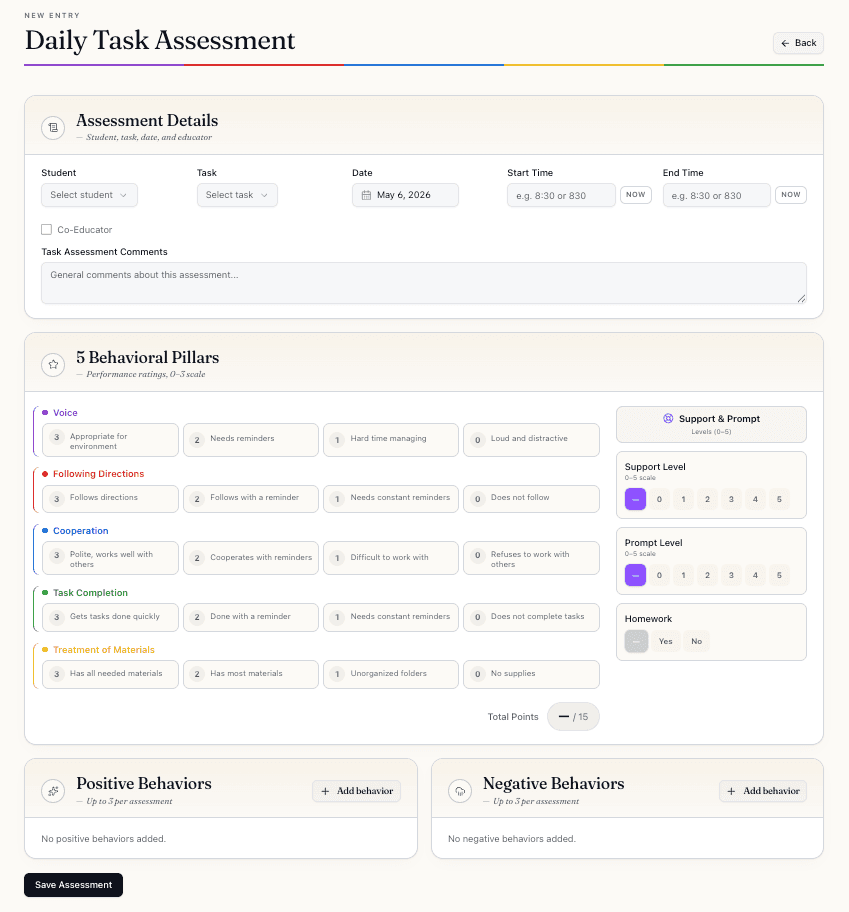
“Built for the rhythm of diverse learners — not a generic LMS.”
Daily Task Assessments aren’t tests. They’re ongoing observations of how students apply foundational skills during real tasks, routines, and activities — data that reflects real behavior in real environments.
Daily task assessment — students, tasks, the five pillars, behaviors and more, all in one form.
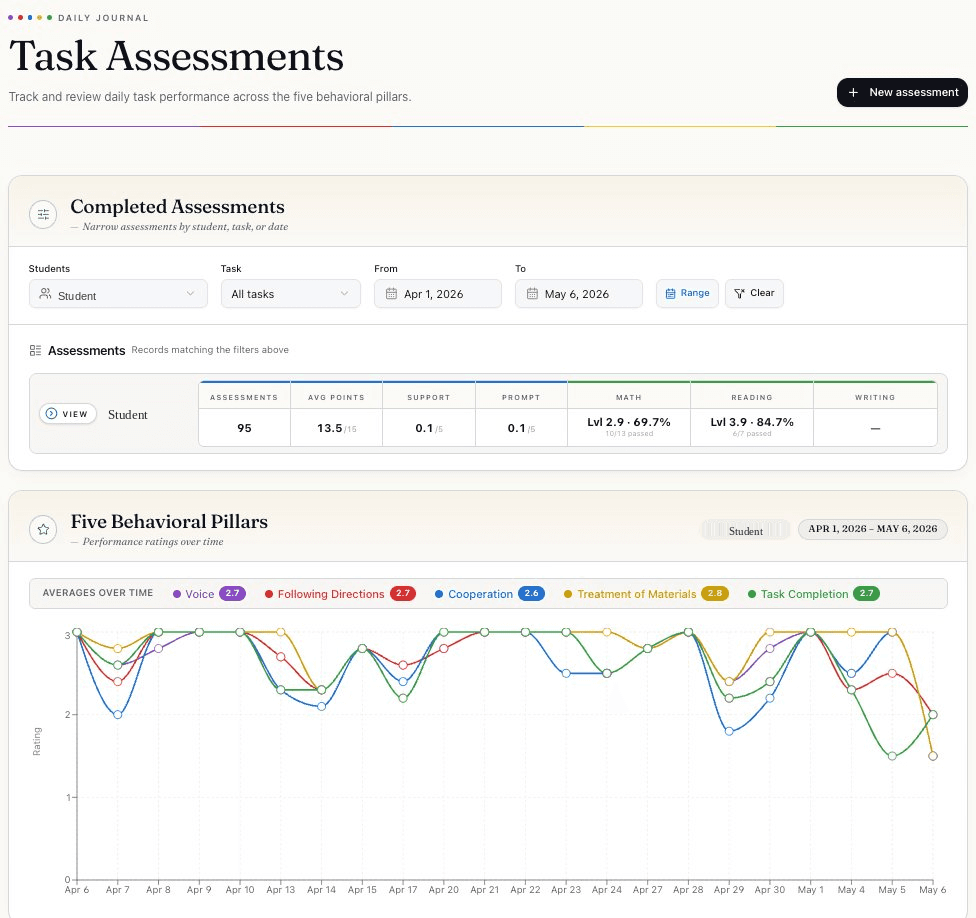
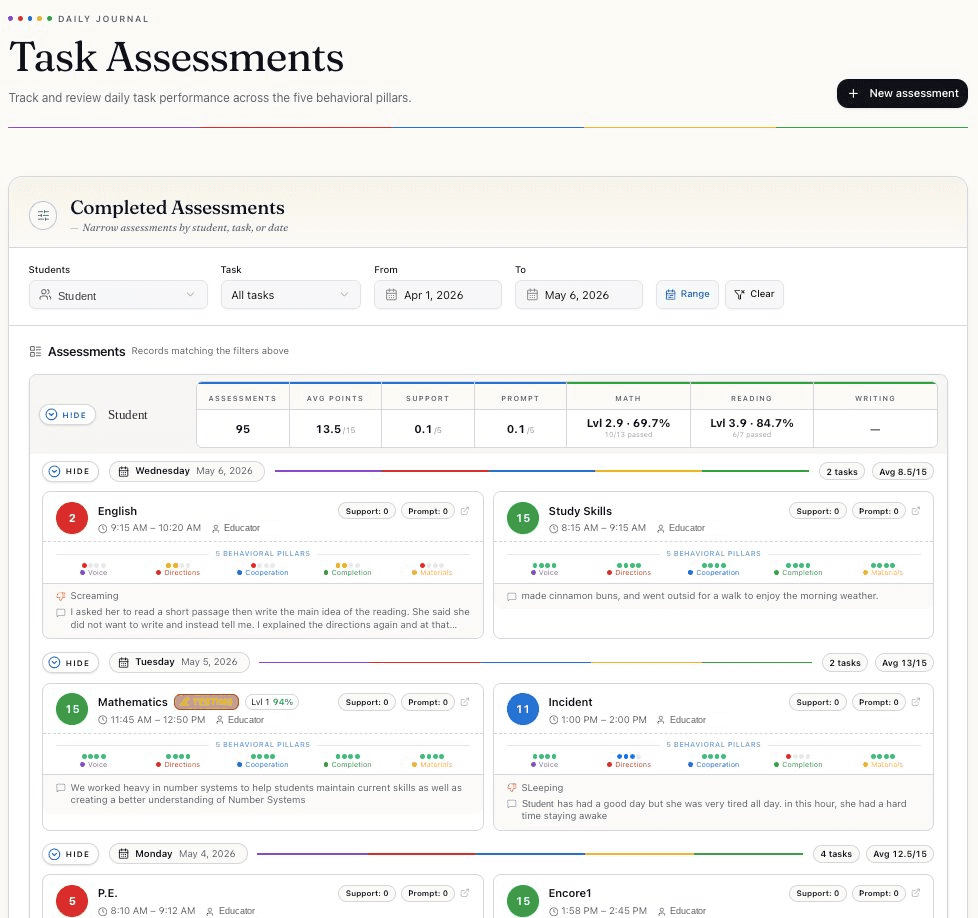
“Your student’s year, on one screen.”
Used consistently, daily observations surface patterns of growth and areas of need — so instruction can be adjusted in days, not quarters, to reduce negative behaviors and strengthen independence.
Five-pillar trends over any range — drill into any day, any student, any task.
“PLAAFPs, FBAs, BIPs, daily success logs — drafted from the data your team already collected.”
Nine built-in reports, including narratives drafted by your highly trained administrative analyst.
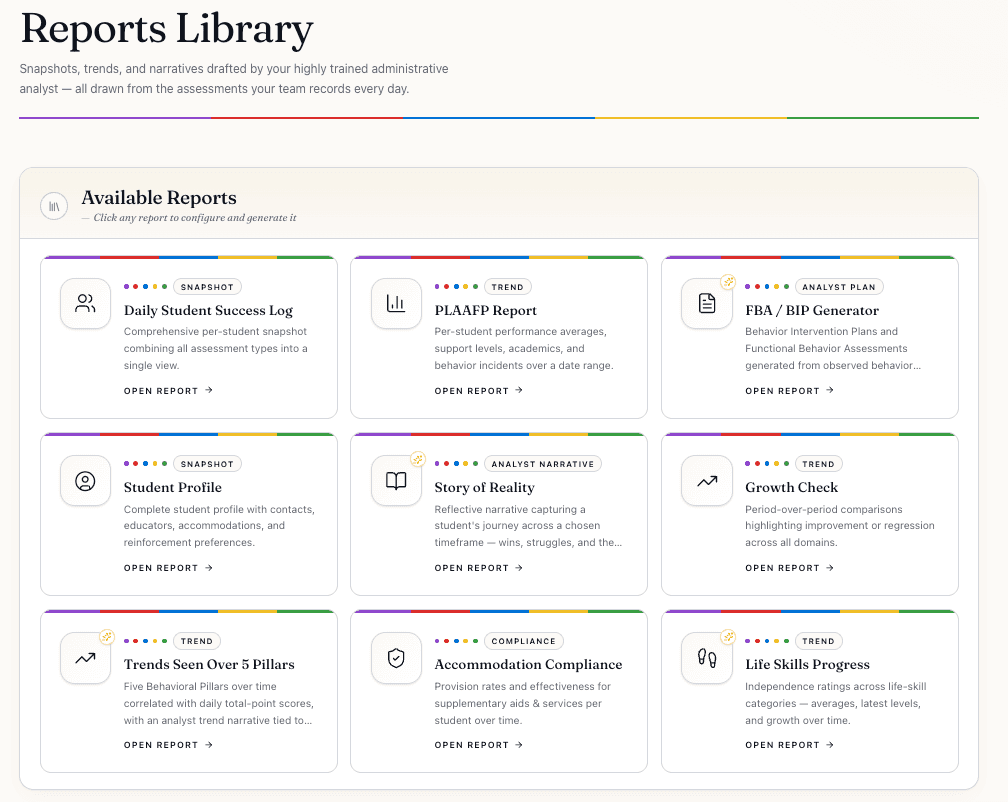
Functions that used to live in three different tools, a binder, and a Saturday — now in one place.
“Responsive, intentional, grounded in what students need right now.”
Effective teaching for diverse learners isn’t one intervention bolted onto the schedule. It’s a continuous system of guidance that helps students access learning, regulate behavior, and build independence across every environment.
S4S keeps that system visible in the day-to-day: support and prompt levels tracked alongside the pillars, tied to specific tasks, and ready to recalibrate the moment a student’s needs change.
“Designed to come off — not to stay on forever.”
Every accommodation is treated as an intentional support — there to open access and reduce barriers, not as a permanent fixture. S4S monitors each one in real time and ties it back to the pillars: is it actually improving performance, reducing negative behaviors, and growing independence?
The result is a tighter, evidence-driven set of supports that flexes as students grow — with clear documentation when it’s time to fade one out, swap it, or add another.
My family has greatly benefited from the Support for Success daily reports regarding my child. These reports provide valuable insight into areas where my child may need additional support, allowing us to reinforce those skills at home. They also keep us informed about my child's emotional regulation and use of coping strategies throughout the day. I truly appreciate the consistent and open communication Support for Success provides, as it enables us to better understand our child's progress and collaborate more effectively in supporting her growth. The reports are clear, easy to understand, and have been a great resource for both my child and our family.
My son has come home from school for years, and when we ask what he did at school, all we get are shrugs. What our family likes about the Support for Success daily reports is that they let us clearly know what he did each day at school. We know when he has done something great or not so great. We know what he did in each class and can easily support what he is learning at school, even if he doesn't want to talk. Another neat thing we like is the success logs on the back of the report. It's like a story about my son's day, as if he wrote it. Sometimes after he shrugs, we ask him to read it to us. It's great to see him smile as he reads, telling us about his day.
Every data point ties back to the five pillars, support level, and prompt level.
Every assessment timestamped, attributed, and exportable.
Special education teachers shaped every screen to ensure efficiency.
Your district’s data is not commingled with another district’s.
Behind every record in S4S is a real child. That’s why the AI that drafts our reports is a private system built for S4S, running on dedicated hardware we own and operate — not a public AI service. Nothing a teacher types and nothing a student does is ever sent to a public AI company, used to train a model, or seen by anyone outside the team serving that student. Every connection is encrypted in transit, end to end.
No public LLM APIs. No model training on student records. No third-party AI subprocessors between your classroom and your reports.
Report narratives are drafted on dedicated hardware we own and operate. Student data never touches a public AI service — and never trains anyone's model.
Every account supports app-based two-factor codes, and sessions live in secure, httpOnly cookies — never in browser storage.
Authorization is enforced on the server for every request. Staff see only what their role requires.
Every create, update, and delete is recorded — who made the change, what changed, and when.
You’ve seen the story and the screens. The next step is a live walkthrough of the full system — your questions, your scenarios, your schedule.